Silent postal code
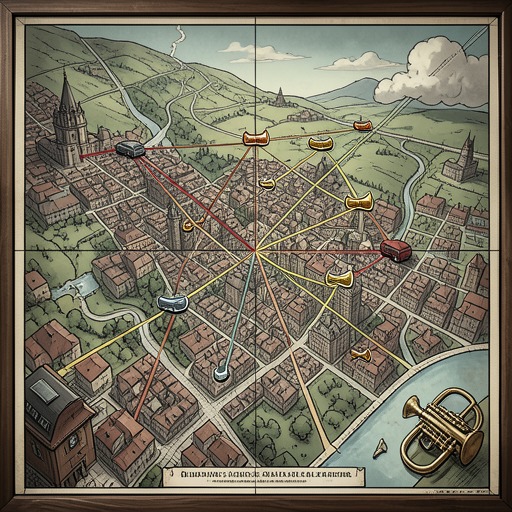
The Crying of Lot 49The muted post horn is the emblem that turns scattered marks into a possible history of clandestine communication. Oedipa Maas encounters it in places and forms that seem at first unrelated: beside a message directing correspondents to W.A.S.T.E., on a ring associated with a family story, beneath the surface of a stamp, and on the clothing and equipment of people she meets in California. Its resemblance to the conventional post horn of the Thurn and Taxis postal service gives the mark a historical and political dimension; its added mute suggests an effort to silence that earlier emblem. Yet the symbol never settles into a single, fully verified explanation. It is at once a clue to the Tristero and a sign whose accumulating appearances sharpen Oedipa’s uncertainty.## Appearance and Recognition At the Scope, Oedipa first sees a loop, triangle, and trapezoid pencilled beneath a notice inviting people to contact Kirby through W.A.S.T.E. She copies both the address and the unfamiliar figure into her notebook. The sequence matters: the symbol appears alongside instructions for a communication route that bypasses ordinary public channels, before Oedipa knows whether the mark names an organization, a service, or something else. The accompanying notice is not enough to explain it, but it gives the figure a practical context: someone is using it where private contact is being solicited.
A historical account adds a more ominous possible meaning. At Fangoso Lagoons, a marker recalls a 1853 attack on Wells, Fargo men by masked marauders in black. Its sole witness reported a cross traced in the dust, and the attackers’ identities remain unknown. Oedipa wonders whether the cross might instead have been the initial T, linking the marker to Niccolò’s trace in The Courier’s Tragedy. The connection is an interpretation rather than proof, but it joins the symbol to a history of contested mail routes and unexplained violence.
The mark appears again on a gold signet ring that Mr Thoth says his grandfather took from one of the people he killed. In Mr Thoth’s account, the attackers were disguised as Indians, and his grandfather distinguished them from actual Native people by their customs and nighttime attacks. Oedipa recognizes the same W.A.S.T.E. figure on the ring. The inherited object thus ties the emblem to a family memory of masked raiders, while the remembered name for them remains unavailable to Mr Thoth. The symbol seems to preserve a connection that the story attached to it cannot fully recover.
The Post Horn and Its Mute
The clearest explanation comes from Genghis Cohen’s examination of stamps in Pierce Inverarity’s collection. He shows Oedipa a 1940 United States Pony Express commemorative stamp, cancelled and marked on its reverse with a watermark resembling the figure she has seen before. He also produces a German stamp bearing the name Thurn und Taxis. Its corners display a post horn with a single loop, the historical postal service’s emblem. Cohen explains that Thurn and Taxis served as Europe’s mail service from about 1300 until Bismarck bought it out in 1867.
The comparison changes the apparent W.A.S.T.E. sign from a free-standing geometric design into a modified postal emblem. Oedipa recognizes that Cohen’s watermark is nearly the same as the horn, except for a small projection from its bell. Cohen suggests that this addition is a mute. In light of the black costumes and secrecy associated with the supposed network, Oedipa infers that its aim was to mute the Thurn and Taxis horn. The emblem consequently carries a relation of opposition: it resembles the symbol of an established postal power while altering it to signal resistance or silencing.
The watermark is not simply evidence of an unusual stamp variety. Cohen notes that the Pony Express issue and the other stamps in question are normally unwatermarked; their hatching, perforations, and paper condition identify the example as a counterfeit rather than a printing error. The mark’s appearance on a falsified postal object therefore joins the symbol to deliberate alteration of official media. The stamp can carry a sign that ordinary versions do not, but the evidence establishes neither who made the counterfeit nor who placed it in the collection.
Circulation Through California
In San Francisco, Oedipa tries to test whether the pattern can be made to disappear by leaving the estate’s tangible assets behind and wandering at random. Within an hour, she sees the emblem again: a man in a suede jacket wears a small pin shaped like the Trystero post horn, visibly muted. The encounter gives the sign a living bearer rather than another archival or historical trace. It does not establish the wearer’s identity or explain his connection to the network, but it frustrates Oedipa’s attempt to treat the mark as a coincidence limited to the estate.
The symbol also appears in a more threatening form on the back of a bus seat. There it is paired with the word DEATH and a pencilled warning whose wording Oedipa remembers as, “DON’T EVER ANTAGONIZE THE HORN.” A separate notice at a laundromat uses the sign as an invitation to seek further information, suggesting that the emblem can serve both as warning and as a way to locate people who recognize it. These uses do not resolve what the Horn can do. Instead, they make recognition itself feel consequential: the same figure may point toward communication, affiliation, or danger.
The clandestine postal route gives that possibility a material counterpart. Beneath a freeway, Oedipa finds a nearly four-foot-high green trash can with a swinging trapezoidal lid. Its initials are hand-painted W.A.S.T.E., with the periods easy to miss. She watches a young man deposit letters, then adds a sailor’s letter addressed to Fresno. Later, a carrier unlocks a side panel and removes the mail; after following him across Market Street and through a sack exchange near City Hall, Oedipa boards the transbay bus after his journey toward Oakland. The mailbox does not display the post horn in this encounter, but its name and concealed collection method connect the sign’s network of private communication to a working delivery system.
Historical and Interpretive Significance
The emblem gathers together Oedipa’s developing picture of Tristero. She understands the organization as having opposed Thurn and Taxis in Europe and, before 1853, having appeared in America against the Pony Express and Wells, Fargo, either as black-clad outlaws or as people disguised as Native Americans. In her account, the network survives in California through W.A.S.T.E. and other possible channels. The muted horn condenses this proposed history into one portable image: a postal sign altered to mark an adversarial alternative to official delivery.
The sign’s force depends on repetition without final confirmation. It recurs across a bathroom wall, a ring, counterfeit postal material, a lapel pin, a bus seat, a public notice, and the broader W.A.S.T.E. system. Each medium changes what can reasonably be inferred. A watermark points to altered paper; a pin makes the sign wearable; a warning assigns it a menacing tone; a mailbox demonstrates that hidden delivery can be physically organized. Together they form a trail, but they do not prove that every appearance belongs to one coordinated source. The emblem therefore operates both as a clue Oedipa can follow and as a device that makes apparently separate things seem connected.
That uncertainty is central to its narrative role. Oedipa’s discoveries encourage a coherent account of Tristero, but the evidence also leaves room for coincidence, invention, or projection. The post horn’s recurrence does not end the mystery; it multiplies the occasions on which interpretation is required. Its mute is especially apt: it names an attempt to silence a postal emblem, while the altered mark itself keeps speaking through objects and routes that official systems would not readily explain.